
Table of Contents
ToggleTired of running the washing machine twice a week? Industrial washers and dryers, also called commercial-grade or heavy-duty units, are gaining traction among homeowners who’ve hit the limits of standard residential equipment. Whether you’re managing a large household, dealing with bulky loads like comforters and rugs, or simply want appliances built to last 15+ years instead of 8, these machines deliver real advantages. But jumping to industrial equipment isn’t a simple upgrade. It requires different plumbing, electrical capacity, venting, and significantly more floor space. This guide breaks down what sets industrial laundry equipment apart, the practical realities of home installation, and how to figure out if it makes sense for your situation.
Key Takeaways
- Industrial washers and dryers offer significantly larger capacity (6.5–18 cubic feet vs. 4.5–5.5 for residential units) and can reduce laundry loads by 20–40% while cutting drying time by 20–30 minutes per cycle.
- Industrial-grade equipment is built for 15+ years of use with heavier-gauge steel and commercial-grade components, compared to 8–10 years for standard home appliances, making long-term repairs and replacement costs more economical.
- Installation of industrial washer and dryer units requires electrical panel upgrades (240V–480V dedicated lines), upgraded plumbing with higher water flow capacity, and professional venting—expect $2,000–4,000 in utility installation costs.
- Industrial washers and dryers cost $1,500–3,500 (washers) and $1,200–3,000 (dryers), but individual replacement parts are modular and inexpensive compared to residential units, potentially offsetting the higher initial investment over 25 years.
- Industrial laundry equipment makes financial sense for long-term homeowners managing large households, bulky loads, or frequent laundry demands, but not for renters or those planning to move within 5–7 years.
- Establish your current electrical and plumbing capacity before purchasing an industrial washer and dryer; undersized utilities often cost more to upgrade than the appliances themselves.
What Makes Industrial Washers and Dryers Different From Standard Home Appliances
The core difference comes down to design philosophy. Standard home washers typically hold 4.5 to 5.5 cubic feet of laundry and cycle through in about 45 minutes to an hour. Industrial washers start at 6.5 cubic feet and scale up to 10–18 cubic feet, meaning you can wash a king-size comforter, heavy work clothes, or several loads’ worth of fabric in a single cycle. These machines also spin faster and extract moisture more efficiently, shortening drying time.
Industrial dryers operate at higher temperatures and with more powerful airflow than residential models, translating to faster drying. They’re built with heavier-gauge steel, reinforced motors, and commercial-grade components rated for frequent, continuous use. A standard home dryer is engineered for roughly 8–10 years of typical family use. An industrial dryer is designed for 10+ years of daily cycling in a laundromat or commercial setting, which translates to exceptional longevity in a home.
Electrically, industrial equipment differs significantly. Most residential units run on standard 120V/240V circuits. Industrial washers typically need 240V dedicated lines with higher amp capacity (30–50 amps depending on the model). Dryers may require 480V three-phase power or heavy 240V single-phase setups. This isn’t a case of swapping the plug, you’re looking at electrical panel upgrades and licensed electrician involvement.
Key Advantages of Industrial-Grade Laundry Equipment
Capacity and Speed Benefits
The most obvious win: you handle more fabric in fewer cycles. A household doing 12–15 loads per week could potentially drop that to 8–10 loads with industrial capacity. For families with kids, athletes, or anyone generating heavy dirt loads (contractors, veterinarians), this saves real time and energy.
Speed matters too. Industrial washers cycle in 30–45 minutes and extract so much water that your dryer runtime drops by 20–30 minutes. Over a year, that’s dozens of hours reclaimed. And because these machines spin harder, they’re actually gentler on delicate fabrics, the mechanics rely on centrifugal force rather than prolonged heating to remove water.
Durability and Longevity
Commercial-grade equipment carries warranties reflecting their expected lifespan. While a standard residential washer may have a 1–2 year full coverage warranty, industrial units often include 3–5 year warranties on parts and labor, with some manufacturers offering extended coverage to 10 years. Parts availability is also broader, industrial equipment is a proven category with established supply chains.
Repair costs tell another story. When a residential dryer’s thermal fuse blows, you might pay $400–600 for the part and labor. Industrial equipment components are modular and less expensive to replace individually. Plumbing is simpler too, industrial units use standard threaded connections rather than proprietary quick-connect fittings, so any plumber can service them.
Installation, Space, and Utility Considerations
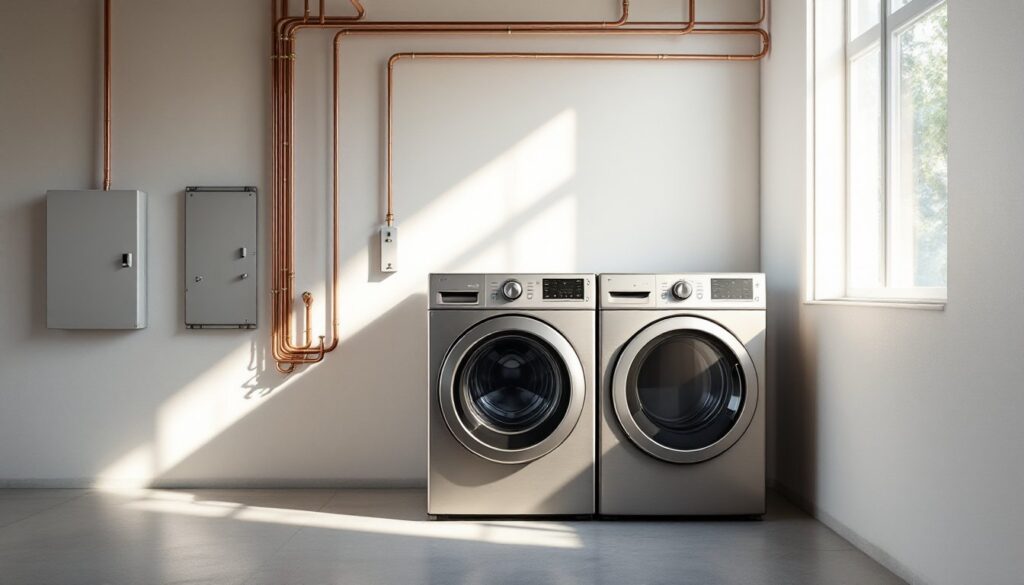
This is where industrial equipment gets real. First, space: these machines are substantially larger and heavier than residential units. A standard front-loader measures roughly 27 inches wide by 30 inches deep by 40 inches tall and weighs 150–200 pounds. Industrial washers often run 28–32 inches wide by 34–40 inches deep by 42–48 inches tall and weigh 300–500 pounds. Dryers follow similar proportions. You’ll need a dedicated laundry room or reinforced basement space, not a closet, and stacking may not be practical even though some space-saving options like stackable washer and dryer models.
Utility hookups demand professional installation. Water lines need to be upgraded to handle the higher flow demands, industrial washers pull 10–15 GPM (gallons per minute) vs. 5–8 for residential models. You’ll need separate hot and cold supply lines with 3/4-inch minimum diameter and a properly sized drain that can accept the volume without backing up. Many homes have inadequate drainage to the sump or municipal system, requiring a plumber to assess and potentially upgrade the line.
Venting for the dryer requires a dedicated, unobstructed duct run straight outside or to a properly sealed exterior vent. Industrial dryers produce more heat and moisture, so undersized ducting reduces efficiency and creates condensation issues. The electrical work isn’t a DIY task, you’re looking at panel upgrades, new circuits, and inspection by the local building department.
Gas hookups (if applicable) must also meet code. Budget $2,000–4,000 for professional installation of water, drainage, electrical, and venting combined, depending on your home’s current setup.
Choosing the Right Industrial Washer and Dryer for Your Home
Start by measuring your laundry room and checking your current utilities. If you lack dedicated 240V power, the electrical upgrade alone will be $1,500–2,500. If your plumbing is old and undersized, add another $1,000–2,000. These hidden costs often exceed the price of the appliances themselves.
Capacity-wise, 6.5–8 cubic feet covers most households comfortably. Going beyond 10 cubic feet adds cost and size with diminishing returns unless you’re running a small rental property. Look for washers with adjustable water level controls rather than fixed-fill designs, you’re paying premium prices: they should adapt to small and large loads alike.
Dryer type matters. Vented dryers are less efficient but cheaper and simpler to vent. Condensing dryers capture and recycle heat, cutting energy use by 30–40%, but they’re pricier and require regular maintenance of the condensate drain. Gas dryers heat faster than electric: electric models are easier to install in homes without gas lines.
Brand reputation counts. Look for units with established parts networks and positive reviews from actual laundromat operators and multi-family property managers, not just home users. Electrolux, Maytag Commercial, and Speed Queen are well-known, but regional suppliers often carry reliable alternatives at better pricing.
Don’t overlook control options. Simpler mechanical controls (knobs and dials) are more durable and easier to repair than digital touchscreens. Many commercial units skip smart features entirely, which appeals to people who want gear that just works for decades.
Cost Expectations and Long-Term Value
Industrial washers range from $1,500–3,500 depending on capacity and features. Dryers run $1,200–3,000. These are real money, double or triple the cost of matching residential units. But the math shifts when you factor in longevity and repairs.
A standard residential washer costs $600–1,200 and typically lasts 8–10 years before major repairs become common (replacing the drum, motor, or control board easily tops $400–800). Over 25 years, you might replace it two or three times. An industrial washer at $2,500 that runs 15+ years with minimal repairs spreads the cost differently, especially if replacement components are cheaper and less frequent.
Energy consumption is mixed. Industrial units use more water and energy per cycle due to their capacity, but fewer cycles offset this, your annual utility bill might be similar or slightly higher even though the raw power draw. But, energy-efficient models with better insulation and controls can reduce costs noticeably. Check EnergyGuide labels and ask about utility rebates in your area: some regions offer credits for commercial-grade laundry equipment that reduces water consumption.
Maintenance adds value too. A $25 thermal fuse beats a $400 repair call. Parts like water inlet valves, drain pumps, and motor bearings are modular and inexpensive on industrial equipment. Many owners report replacing just one or two components over a decade, versus residential machines that fail more comprehensively.
If you’re staying in your home long-term, enjoy large loads, and can absorb the installation costs, industrial equipment often pays for itself in reduced downtime and repair expenses. For renters or those planning to move within 5–7 years, stick with standard residential units, the upfront investment and installation logistics don’t pencil out. Home organization experts at Real Simple and resources like The Spruce offer additional guidance on optimizing laundry spaces and workflows.