
Table of Contents
ToggleTiny houses are becoming the go-to choice for homeowners who want to downsize without sacrificing comfort. But living small comes with unique challenges, especially when it comes to wastewater management. A standard septic system designed for a 3,000-square-foot house won’t cut it in a 400-square-foot tiny home. The good news: selecting and maintaining a septic tank for tiny house applications is entirely doable with the right knowledge. This guide walks you through the essentials of tiny home septic systems, from understanding your options to keeping everything running smoothly for years to come.
Key Takeaways
- A septic tank for tiny house applications requires smaller capacity (500–750 gallons) and careful sizing based on actual water usage of 40–60 gallons per day, not oversized conventional systems.
- Gravity-fed systems remain the most practical and affordable option for tiny homes ($2,000–$4,000), while aerobic treatment units offer smaller drainfield footprints for tight lots but cost more and require regular maintenance.
- Proper permitting and professional installation are essential to avoid costly mistakes like improper pipe slope, inadequate depth, or poor tank placement that can lead to system failure within 5–10 years.
- Maintenance practices are critical in tiny house septic systems—pump every 3–5 years, use septic-safe toilet paper, avoid harsh chemicals, and never flush wipes or non-biodegradable items that clog smaller tanks.
- Planning your septic system during tiny house design saves thousands by avoiding retrofitting and allows for space-saving innovations like mound systems or composting toilets paired with greywater solutions.
- A well-maintained septic tank for tiny homes lasts 25–30 years, while early intervention on warning signs like wet spots or odors prevents emergency replacements costing $5,000–$15,000.
Why Tiny House Septic Systems Are Different
A tiny house septic system operates on the same basic principles as a conventional system, but scale matters tremendously. Tiny homes generate significantly less wastewater than standard houses, a family of two in a tiny house might use 40-60 gallons per day compared to 300-400 gallons in a conventional home. This reduced load changes everything about system design, sizing, and maintenance frequency.
Because tiny homes are often built on small lots or in rural areas without municipal sewer access, they rely heavily on septic solutions. The challenge isn’t just installing a smaller tank: it’s choosing a system that matches your actual usage patterns without oversizing (which leads to poor biological function) or undersizing (which causes frequent pumping and system failure).
Tiny house septic systems also benefit from tighter construction standards. Many tiny homes are built by experienced builders or as prefab units, meaning you can plan wastewater management from day one rather than retrofitting an existing structure. This upfront planning is your biggest advantage.
Types of Septic Systems for Tiny Homes
Standard Gravity-Fed Systems
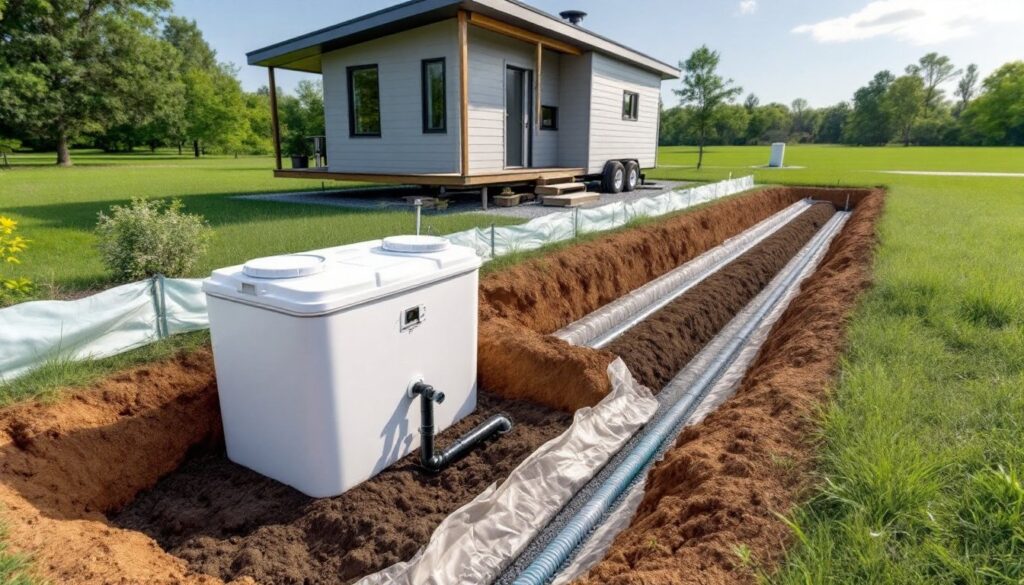
For most tiny homes, a traditional gravity-fed septic system remains the most practical choice. These systems consist of a small septic tank (500-750 gallons for a two-person household), a distribution box, and a drainfield. Wastewater flows by gravity from the house into the tank, where solids settle and decompose, then exits to the drainfield where soil naturally filters it.
Gravity systems work beautifully when you have adequate lot size and suitable soil percolation rates. A professional percolation test (perc test) determines whether your soil can absorb water at the right speed, typically 1-6 inches per hour for standard systems. Many jurisdictions now require this test before permitting.
Key advantage: Low maintenance, no power required, and proven reliability over decades. Drawback: You need sufficient land for the drainfield, typically 1,000-1,500 square feet even for a tiny home system.
Aerobic Treatment Units
Aerobic treatment units (ATUs) use air to speed up bacterial decomposition of waste, creating a more “finished” effluent that can be dispersed into smaller drainfields or even surface irrigation on poor soil. These systems are ideal when lot size is tight or soil conditions aren’t ideal.
ATUs require electricity to run an air pump and typically need a timer to control cycles. They also demand more hands-on maintenance, you’ll need to inspect the unit monthly and have it serviced annually. The biological process inside is more aggressive, so keeping the system properly balanced is crucial.
Key advantage: Smaller drainfield footprint (as little as 250-500 square feet). Drawback: Higher upfront cost ($4,000–$8,000 installed vs. $2,000–$4,000 for gravity systems), ongoing electricity use, and more frequent professional service. Consider modern tiny home design approaches when planning your system placement.
Space-Saving Designs: The Key Advantage
Tiny homes benefit from innovations in compact septic design. A standard 1,000-gallon tank measures roughly 6 feet wide by 10 feet long: smaller tanks drop to 500 gallons and compact further. Fiberglass and plastic tanks are lighter and easier to maneuver into tight spaces compared to concrete. Concrete tanks (600-1,000 pounds) can crack if dropped, while fiberglass units weigh half as much and resist corrosion indefinitely.
For truly minimal footprints, mound systems elevate the drainfield above natural grade, allowing treatment in poor-draining soils using only 500-600 square feet. Alternatively, sand filter systems pre-treat septic effluent through a sand bed before it reaches the drainfield, reducing required land by 30-40%.
If you’re dealing with extremely limited space, composting toilets paired with a greywater system eliminate the need for a full septic tank altogether. You’d separate toilet waste (composted on-site) from shower and sink water (handled by a small greywater system). This approach requires careful design and usually needs creative tiny home solutions to work smoothly.
The real win: planning these systems during tiny house design means running smaller-diameter pipes, positioning tanks where they won’t interfere with living space, and avoiding the cost and hassle of retrofitting later.
Installation and Permitting Considerations
Don’t skip permitting. Every septic system, including those in tiny homes, requires a health department permit in almost all jurisdictions. Inspectors confirm proper system sizing, tank placement (minimum 50 feet from wells, typically 5-10 feet from structures), and drainfield slope and setbacks.
Before hiring an installer, request a site plan showing tank location, drainfield layout, well placement, and property lines. The health department reviews this before issuing a permit. Installation costs vary widely by region ($2,000–$5,000 for a simple gravity system), but expect to pay more if excavation is difficult or soil needs amendment.
Key installation steps:
- Obtain the health department permit and perc test results
- Mark tank and drainfield locations with stakes
- Excavate the tank pit to proper depth (tank should be level)
- Set and level the tank, backfill carefully to avoid settling
- Install distribution box, inlet/outlet baffles, and drain pipes with proper slope (1/8-inch per 10 feet is standard)
- Lay drainfield lines with gravel and geotextile fabric
- Schedule final inspection before covering
Most DIYers can handle site layout and grading, but tank installation and pipe work usually require a licensed septic contractor. This isn’t a corner-cutting area, improper slope or pitch causes clogs: inadequate depth causes freeze-thaw damage: loose backfill causes tank settlement and pipe damage. Professional guidance on system installation is money well spent.
Maintenance Tips to Keep Your System Running Smoothly
A tiny home septic system requires less frequent pumping than a standard home, every 3–5 years instead of every 2–3 years, because fewer people use it. But, maintenance practices are even more critical in a small system because there’s zero buffer for careless use.
Do’s:
- Pump the tank on schedule (get a reminder from your pumping service)
- Use single-ply, septic-safe toilet paper that breaks down quickly
- Spread water use evenly (avoid huge loads of laundry in one day: it overloads the drainfield)
- Install lint filters on washer discharge lines
- Keep a detailed maintenance log with pumping dates and observations
Don’ts:
- Never flush wipes, feminine products, coffee grounds, or “flushable” anything
- Don’t use caustic drain cleaners: use a plumbing auger or call a plumber
- Don’t park vehicles or build structures over the drainfield
- Don’t use excessive amounts of bleach or antibacterial soap (they kill beneficial bacteria)
- Don’t ignore warning signs: slow drains, wet spots over the drainfield, or odors
For a tiny home septic system handling 40-60 gallons daily, water conservation is naturally built in, but mindful habits extend tank life. A properly maintained system lasts 25–30 years: a neglected one fails in 5–10 years.
If you notice wet patches, pooling, or odors near the drainfield, that’s a sign of saturation or failure. Depending on severity, you might need drainfield repair (installing a new field beside the old one) or aerobic treatment to reduce effluent volume. Early intervention prevents emergency replacement, which costs $5,000–$15,000.