Table of Contents
ToggleNew England‘s picturesque towns and high cost of living have sparked a growing interest in tiny homes as a practical alternative to traditional housing. Homeowners across Massachusetts, Connecticut, Vermont, and beyond are discovering that smaller spaces don’t mean sacrificing comfort or quality of life. Whether motivated by financial freedom, sustainability, or the appeal of low-maintenance living, tiny homes offer a compelling solution for those ready to downsize without downsizing on functionality. This guide explores why tiny living makes sense in New England and how to design, maintain, and truly thrive in a compact space within this demanding climate.
Key Takeaways
- New England tiny homes—typically 400–800 square feet—offer significant affordability advantages, with purchase prices like $250,000 compared to $400,000+ for conventional homes in the region.
- Superior insulation (R-19 to R-21 walls, R-38 to R-49 attic) and high-efficiency heating systems are essential for surviving New England winters and minimizing fuel costs in tiny homes.
- Smart storage solutions—including vertical shelving, built-in benches, lofted bedrooms, and external sheds—prevent cramped feelings and maximize functional living space in compact layouts.
- Open-concept layouts with intentional zoning, higher ceilings (9–10 feet), and abundant natural light make tiny spaces feel significantly larger and more livable.
- Outdoor areas like decks, patios, and three-season porches become essential overflow living space that nearly doubles perceived square footage during warmer months.
Why New England Homeowners Are Choosing Tiny Living
New England real estate prices are among the highest in the nation. A modest single-family home in suburban Boston, Providence, or Hartford can easily exceed $400,000, while comparable space in nearby states costs significantly less. Tiny homes, typically between 400 and 800 square feet, offer an escape hatch from this affordability crisis.
Beyond dollars and cents, many homeowners cite lifestyle reasons. The COVID-era work-from-home shift convinced plenty of people they didn’t need sprawling suburban lots. Retirees are downsizing to reduce maintenance and property taxes. Young families appreciate the forced intentionality: owning fewer possessions, building closer relationships, and spending less time cleaning means more time living. Tiny homes also align with growing environmental concerns: a smaller footprint naturally cuts heating, cooling, and resource consumption.
Another draw is the path to ownership itself. A $250,000 tiny home feels vastly more achievable than a half-million-dollar conventional house, especially for first-time buyers. The Great Lakes Tiny Homes: model demonstrates how regional variants of tiny living attract specific demographics. New England’s version blends Yankee pragmatism with contemporary sustainability values, a combination proving attractive across age groups and income levels.
Navigating New England’s Climate in a Tiny Home
Winters in New England are unforgiving. Temperatures routinely drop below zero in Vermont and Maine, while coastal areas experience nor’easters and ice dams. Building and maintaining a tiny home here demands respect for climate realities, not wishful thinking.
Energy Efficiency and Winter Readiness
Tiny homes have a natural advantage: less volume to heat means lower fuel costs and faster warm-up times. But, smaller doesn’t mean “well-insulated by default.” Success hinges on construction choices made during the building or renovation phase.
Insulation is non-negotiable. The walls, attic, and rim joists must exceed standard codes. Most New England tiny homes use R-19 or R-21 wall insulation (versus the code-minimum R-13 in many regions) and R-38 to R-49 attic insulation. Double-stud walls (built from two 2×4 studs rather than one) are common in premium tiny builds, allowing thicker insulation layers. Spray foam or blown-cellulose fills cavities completely, eliminating thermal bridging where studs conduct cold. Ground-floor sill plates require rigid foam underlayment to prevent heat loss where rim joists meet the foundation.
Windows account for 30% of winter heat loss in small homes. Invest in triple-glazed, low-emissivity windows rated for your zone (ENERGY STAR certified for your state). South-facing windows admit solar gain even in winter: north-facing windows should be minimal or high-performance. Proper caulking and installation aren’t optional, air leaks undermine insulation.
Heating system sizing is critical. An oversized furnace short-cycles, wasting fuel. Undersizing leaves you cold and frustrated. Tiny Home Insulation: Unlock provides depth on this decision. Many New England tiny homeowners pair a high-efficiency central heat pump (SEER 16+, HSPF 9+) with a backup propane or wood stove, hedging against grid failures during ice storms.
Moisture management becomes critical in tight spaces. In winter, interior humidity rises from cooking, showers, and occupant breath. Without proper ventilation, condensation collects on windows and eventually causes mold. Install an ERV (Energy Recovery Ventilator) or HRV (Heat Recovery Ventilator) with ductwork to continuous code-required air changes. These units exhaust stale interior air while capturing heat from the outgoing stream, prewarming incoming fresh air. Proper bath and kitchen exhaust fans, vented outside (not into the attic), are essential.
Drains, water lines, and exposed pipes must be protected or insulated. A freezing risk exists in unheated cavities or exterior walls. Wrap pipes in foam sleeves or heat tape in vulnerable spots. Some builders bury water lines below the frost line, typically 3 to 4 feet deep in New England, rather than running them through rim joists.
Smart Storage Solutions for Compact New England Spaces
Tiny homes force a reckoning with accumulation. Without a basement, attic, or garage, every item must earn its place. Storage done poorly makes a tiny space feel claustrophobic: done well, it’s invisible.
Begin with vertical storage. Wall-mounted shelving extends usable storage without eating floor area. Floating shelves above a kitchen counter, along a hallway, or beside a bed add shelf real estate without visual weight. Tall, narrow bookcases or cabinetry draw the eye upward, psychologically expanding the space.
Built-ins are workhorses. A bench under a window with lift-top storage serves seating, meals, and hidden storage in one footprint. Stair treads that open (yes, stairs can have doors) hide winter gear or linens. Under-bed storage boxes, even in a lofted bedroom, tuck seasonal items away. Kitchen islands with shelving below, not just counters on top, double as dining and storage.
Closet organization matters immensely. Don’t rely on a single rod: add shelves above and below the hanging rail. Drawer dividers keep small items tidy. Under-shelf hanging organizers (like those for hangers) create another tier of storage without additional footprint. In a tiny home, how you organize a single closet can feel like gaining square footage.
External storage is worth serious thought. A modest shed (8×10 or 10×12 feet, depending on zoning) holds seasonal decorations, tools, and bulk items. Some tiny homeowners use weatherproof deck boxes or purpose-built garden storage cabinets. This moves non-daily-use items out of the living space entirely. Tiny Home Ideas: Transform explores more organizational strategies.
Measure before buying furniture. Awkward large pieces quickly become immovable obstacles. Favor modular furniture, ottomans, nesting tables, and sectionals that reconfigure, over fixed pieces. A murphy bed or murphy desk transforms a room’s function without structural work. The trick is choosing flexibility without sacrificing durability.
Designing a Functional Tiny Home Layout
Layout is everything in a tiny home. Square footage matters far less than how that footage flows and what uses nest together.
Open-concept living is standard but imperfect. An open kitchen-dining-living area feels larger and allows light and sight-lines to bounce around. But, cooking smells, noise, and visual clutter spread faster. Consider half-walls, partial-height cabinetry, or a strategically placed island to create subtle zones without fully enclosing spaces.
Bedroom placement affects both privacy and thermal comfort. Lofted bedrooms save floor area and suit couples or solo dwellers well, though they sacrifice headroom and create a sweltering sleeping zone in summer if ventilation isn’t designed in. Ground-level bedrooms are easier to navigate and sleep cooler, but consume footprint. Some New England tiny homes position a small bedroom as a true sleeping chamber and repurpose living areas for flexible working or hobby space.
Ceiling height impacts perceived space. Standard 8-foot ceilings in a tiny home feel cramped: 9 to 10 feet noticeably opens things. Vaulted or cathedral ceilings amplify this effect, though they cost more to heat and cool. If possible, push for taller ceilings: the difference in construction cost is modest compared to the livability gain.
Natural light changes everything. Large windows (or skylights in roofs) make tiny spaces feel less cave-like and reduce daytime lighting loads. Position windows to capture views or greenery, not just light. Privacy windows (frosted glass or strategic placement) work in dense neighborhoods.
Photographs from Curbed and interior design platforms show how professional designers solve the same problems repeatedly: dual-purpose furniture, integrated storage, and clear sight-lines. Study real layouts, not just square footage numbers. A well-designed 600-square-foot tiny home feels larger than a poorly laid-out 800-square-footer.
Making the Most of Outdoor Living Areas
In tiny homes, outdoor space becomes essential overflow room. A deck, patio, or yard isn’t a luxury, it’s a necessity for mental health and usable living area.
Decks are popular in New England. A 12×16-foot treated-lumber deck (or composite for lower maintenance) costs $3,000–$6,000 installed and nearly doubles perceived living space during warm months. Composite decking, while pricier upfront ($15–$25 per square foot installed versus $10–$15 for pressure-treated lumber), eliminates annual staining and resists splinters. For tiny homes, the reduced maintenance time justifies the higher initial cost.
Patios offer an alternative, especially on sloped sites. A poured concrete slab costs less than deck framing and works well for tight footprints. Pavers allow flexibility and individual replacement if one cracks.
Three-season porches blur indoor-outdoor boundaries. An unheated sunroom or screened porch (with insulated walls, windows, but no heating) extends usable months and adds light. Some New England builders insulate three-season porches for year-round use, creating a “soft room” for transitional seasons.
Vertical gardens and container planting make small outdoor areas productive. Dwarf fruit trees, raised beds, and trellised vegetables turn a compact yard into a functional garden. This appeals to homeowners who downsized partly for sustainability: growing even a fraction of their food aligns with environmental values.
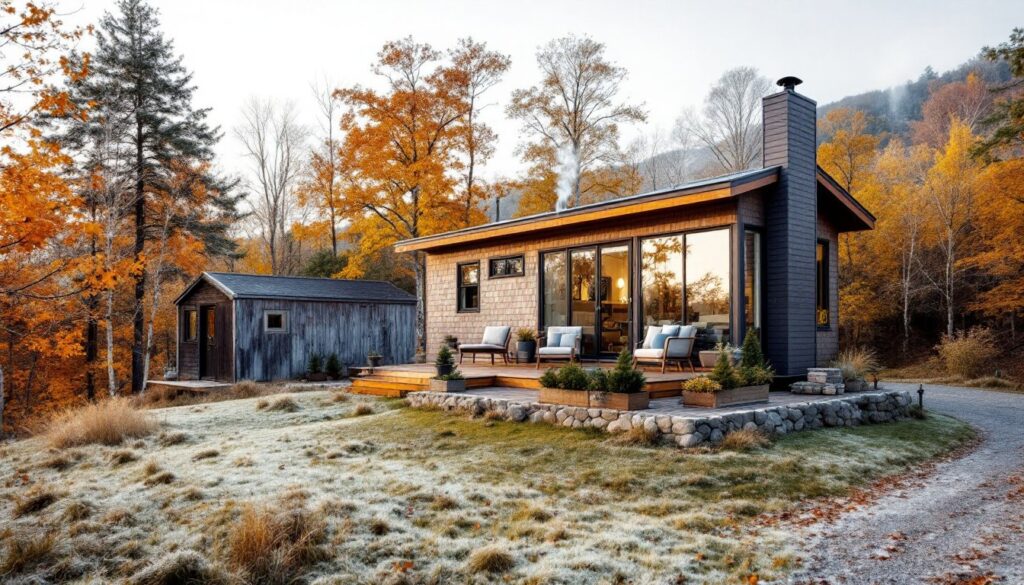
Shedding rain and snow off tiny home roofs onto outdoor living areas creates muddy, wet mess. Plan grading so runoff flows away, and consider gutter extensions or French drains if your lot slopes toward the deck. In winter, a roof raked of snow prevents dangerous ice dams from forming above walkways. Cabin Style Tiny Homes: often feature well-designed outdoor retreats as integral to livability.
For those in dense neighborhoods with shared outdoor space, balconies or patios overlooking community areas can serve a similar psychological function, extending the sense of space even if you’re not physically using it.
Conclusion
Tiny homes in New England aren’t a fad, they’re a practical response to affordability, climate, and lifestyle priorities. Success requires upfront honesty about building science, climate demands, and personal organization habits. Proper insulation, ventilation, heating strategy, and thoughtful layout transform a tiny footprint into genuinely livable space. With rising real estate costs and growing environmental awareness, New England’s tiny home movement will only accelerate. Those willing to commit to the project will find the payoff substantial: lower costs, less maintenance, and more time for living rather than maintaining a house.